CLIMATE FINANCE
BY TAPROOT EARTH
MAY 4, 2026
SHARE:


Last month, before storm season should have even begun, Super Typhoon Sinlaku tore through the Mariana Islands in the western Pacific.
Homes were stripped open, power shut off, and families waited in the dark as the storm barrelled down on them.
In Kenya, after seeing its driest short rain season since 1981, the ground hardened until it could no longer absorb. When the rains came in early March, they came all at once. In Nairobi and surrounding communities, neighborhoods flooded in a day’s time, families were displaced, and already strained infrastructure was and is still overwhelmed.
These are not isolated moments. They are part of a pattern that is becoming harder to ignore. From the Gulf South to the Global South, communities are facing more intense disasters and slower, more fragile recovery. The systems meant to respond are often distant, under-resourced, or unaccountable to the people most impacted.
So the question becomes unavoidable: How do communities preserve, rebuild, and build anew?
We often frame the climate crisis as a problem of emissions, infrastructure, or technology. But beneath every disaster is another layer that shapes what happens next: money.
Who controls it? Who receives it? What conditions are attached to it to determine whether recovery is possible, delayed, or denied altogether?
Today, climate finance is largely controlled by institutions in the Global North and often delivered in extractive forms, including loans that deepen vulnerability rather than resolve it. Decisions are made with little, if any, input from the communities experiencing the crisis, and resources frequently fail to reach those most in need.
As outlined in our newly released report, The Future Is Made of Coral, climate finance is ultimately a question of power. It determines who gets to rebuild, how rebuilding happens, and whether communities can do so on their own terms. Right now, our climate finance system is extractive, but what if there was another way to do it?
Reparative climate finance offers a different path. It calls for resources to be returned, not extracted. It prioritizes grants over loans, it values self-determination over debt, placing decision-making in the hands of frontline communities whose knowledge and leadership are too often overlooked.
Coral reefs offer a different model for recovery. They do not grow endlessly. They rebuild, repair, and renew after disruption, forming structures that protect and sustain the ecosystems around them.
This is the vision behind the Reef Fund.
It is not a single intervention, but a structure that grows over time through collective stewardship.
It is designed to shore up ecosystems and economies damaged by extraction, reimagine places through abundance and re-indigenization, and support communities navigating climate migration on their own terms.
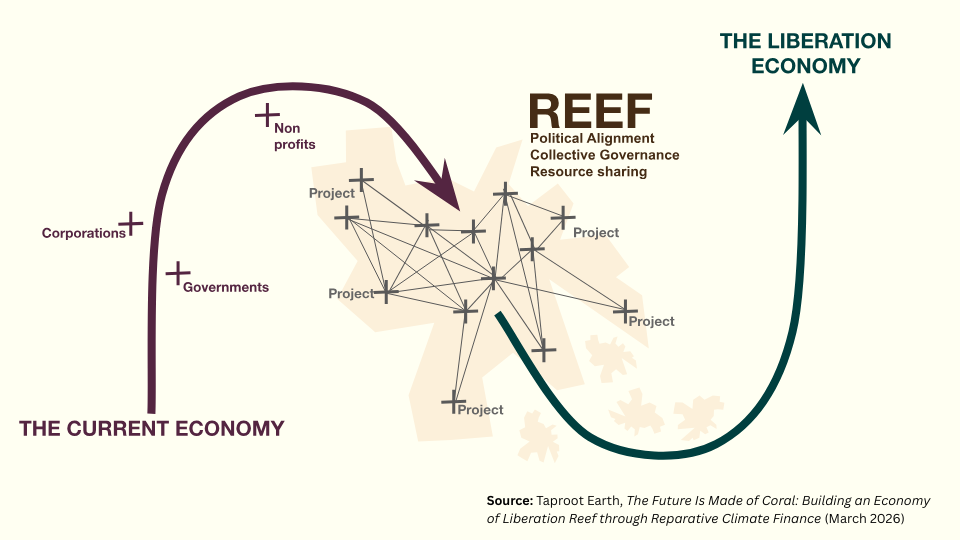
Like coral, the Reef Fund is designed to accumulate strength over time. It is rooted in the belief that those closest to the challenges are also closest to the solutions, and should be trusted to govern the resources that shape their futures.
Across years of organizing, convening, and experimentation, a consistent question has emerged: What would it look like for communities to govern the resources themselves?
This is not an abstract idea. From the Gulf South to Appalachia and across Taproot’s global convenings, frontline leaders have already been practicing forms of collective governance. They have tested what it means to align across regions, navigate differences, and make decisions together about resources and priorities.
The Reef Fund builds on these lived practices. It asks what it would take to scale community-governed finance globally, not as an experiment but as a shift in how climate finance operates.
We are living through a moment of uncertainty in global financial systems. Institutions that have long shaped climate finance are being challenged, and their ability to respond at the scale required is increasingly in question.
The REEF Fund is both a response and an alternative. It is an effort to build a model that can hold communities through crisis while shifting how resources move at a global scale.
This work is not simple. It asks us to confront how money has been used to create harm and imbalance, and to reconsider what it means to move resources with care. It requires trust across difference and a willingness to practice shared stewardship in real time. It also asks us to move beyond scarcity, toward a clearer understanding of what becomes possible when communities have what they need.
The Future Is Made of Coral report is not a final answer. It’s a starting point.
It looks closely at how climate finance currently moves, where it falls short, and what it would take to shift toward something more just. It offers a vision of reparative climate finance rooted in community governance, transparency, and collective care, while pointing toward the work ahead.
Not everything is defined here, and that is intentional. This is not a model being handed down. It is something being shaped over time, through relationships, experimentation, and shared decision-making across regions.
The conditions that brought us here are not going away. Storms will continue and floods will come, but the question of how we preserve, rebuild, and transform remain. What changes is how we respond.
Have a question for TE Speaks? Contact us at media[at]taproot.earth.